02 / ОСНОВНЫЕ ПРОДУКТЫ БЛЮДА
Уличная еда
Непереведённые названия показаны на языке сохранённых данных.
- Flour
- Eggs
- Milk
- Ghee
- Sugar
- Salt
English · русское название ещё не добавлено
01 / О БЛЮДЕ
Исходное описание на английском языке. Русский перевод ещё не добавлен.
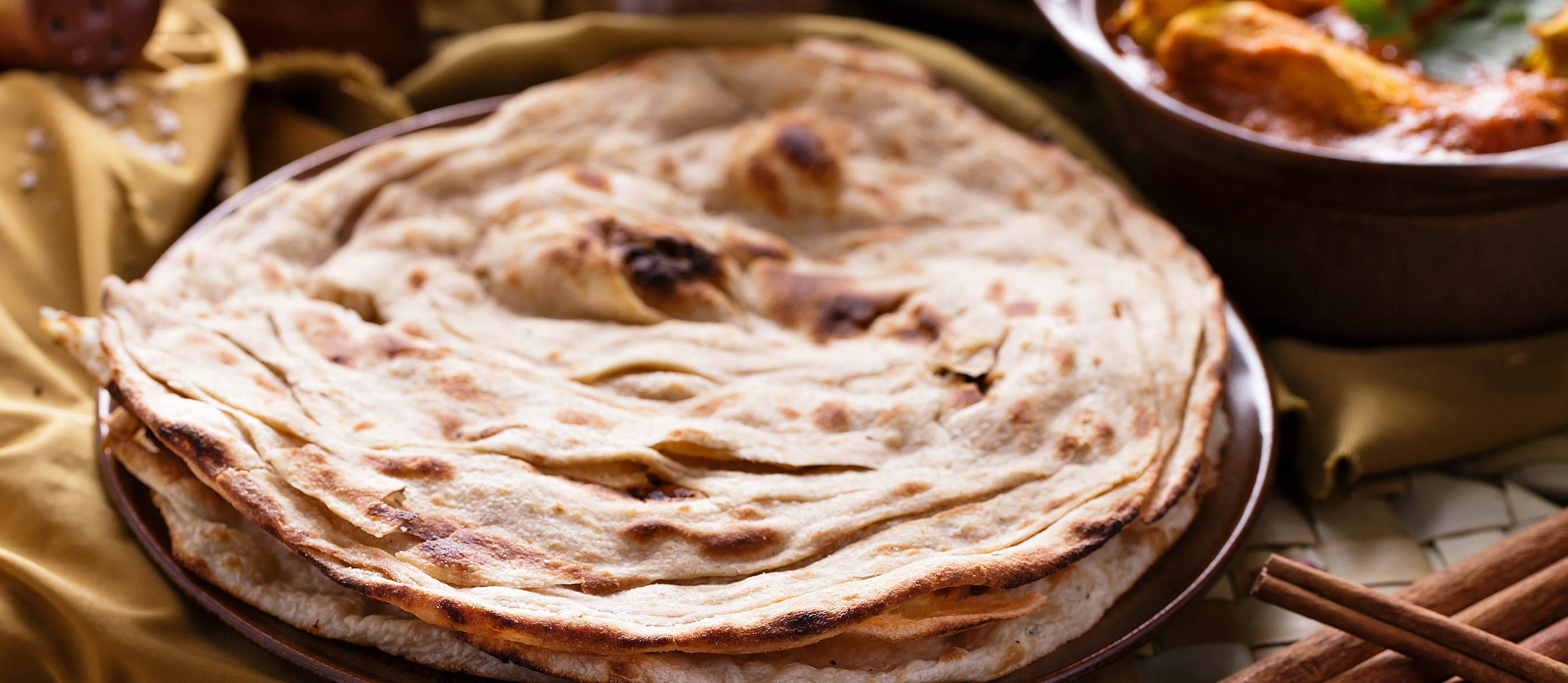
Roti prata is a pan-fried laminated flatbread with a crisp, blistered exterior and a soft, elastic center formed from many thin layers. It is made by stretching wheat dough until almost transparent, coating it with fat, folding or coiling it, and frying it on a flat griddle. Ghee is closely associated with the bread, although margarine and vegetable oil are now equally common. Roti prata is most strongly associated with Singapore, while the closely related form sold in Malaysia is generally called roti canai. Both belong to the wider family of layered flatbreads connected with paratha and the thinner, highly laminated parotta of southern India. Similar breads are also found in Sri Lanka, Myanmar, Thailand, Brunei, and parts of Indonesia. Its development in the Malay Peninsula is connected with migration from the Indian subcontinent during the nineteenth and early twentieth centuries. Tamil Muslim communities from the Coromandel Coast played a particularly important role in establishing food stalls and restaurants in Singapore. Migrants from Kerala and the Malabar Coast also contributed to the broader culinary culture from which prata emerged. Roti prata became closely associated with Indian Muslim food stalls, coffee shops, markets, and later hawker centers. Its modest ingredients, compact size, and substantial energy value made it suitable for workers around ports, commercial districts, and other busy urban areas. However, there is no strong evidence that it began exclusively as a meal for plantation and dock laborers. It developed as an inexpensive everyday food that could be eaten at breakfast, lunch, dinner, or late at night. The name combines two related culinary terms. Roti is an Indo-Aryan word used broadly for bread or flatbread. Prata is generally understood as a shortened local form of paratha or parotta, rather than a separate word meaning only “flat.” The name therefore reflects the bread’s connection with the layered flatbreads of the Indian subcontinent. The dough usually contains strong wheat flour, water, salt, sugar, and fat. Ghee, margarine, or vegetable oil can supply the fat, while some formulas also include egg, milk, or condensed milk for greater tenderness and browning. Commercial yeast and chemical raising agents are generally unnecessary because the layers are created through kneading, resting, stretching, folding, steam, and hot fat rather than fermentation. The dough is kneaded until smooth, elastic, and capable of stretching without tearing. It is then divided into uniform balls and coated generously with oil or fat. The portions must rest long enough for the gluten to relax, commonly for at least one to five hours and sometimes overnight. They do not need to remain completely submerged in oil, although a generous coating prevents the surface from drying and makes the dough easier to stretch. Each rested ball is flattened on an oiled stainless-steel or stone work surface. An experienced vendor lifts, swings, slaps, and rotates the dough repeatedly until it expands into a nearly transparent sheet several times its original size. The rapid movement helps stretch the dough evenly, but the result also depends on properly developed and rested gluten. The sheet can alternatively be pulled outward by hand without being thrown through the air. Fat is spread across the thin sheet before the edges are folded inward. The dough may be folded into a flat square or gathered into a long rope and wound into a spiral. Folding creates overlapping sheets separated by a fine coating of fat, while small pockets of air remain between some of the layers. A coiled portion normally rests again before being flattened for frying. The shaped bread is placed on a hot, well-greased iron griddle. Heat turns the water inside the dough into steam, which expands between the fat-coated layers and pushes them apart. At the same time, direct contact with the griddle produces dark brown blisters and a crisp, golden surface. The heat must be strong enough to brown the exterior without scorching it before the inner dough is fully set. Once the prata leaves the griddle, it is often clapped or compressed quickly from opposite sides. This is not intended simply to crush the bread. It loosens the layers, breaks the rigid outer shell into flakes, releases trapped steam, and helps keep the surface crisp. The motion can be performed between the hands or against a clean work surface and should be firm without reducing the bread to fragments. The plain form is known as roti kosong, meaning empty or unfilled bread. Its flavor comes from toasted wheat, browned fat, salt, and the lightly sweet dough. Roti prata is served immediately while the crust is still crisp and the internal layers remain hot and flexible. It is commonly torn by hand into small pieces, exposing the soft, elastic center. Forks and spoons may also be supplied, especially for filled versions or when several sauces accompany the bread. The standard accompaniments are curries and lentil gravies. A thin, tangy fish curry provides acidity and heat, while mutton or chicken curry gives the bread a richer coating. Dal supplies a milder, earthy alternative based on lentils. Some stalls serve more than one sauce, allowing pieces of prata to be dipped into different gravies during the same meal. Sweet serving styles are equally established. Plain prata can be dipped into coarse white sugar, served with sugar beside the curry, or covered with condensed milk. These combinations are especially common at breakfast and as late-night food, although prata is eaten throughout the day.
02 / ОСНОВНЫЕ ПРОДУКТЫ БЛЮДА
Уличная еда
Непереведённые названия показаны на языке сохранённых данных.
03 / РЕЦЕПТ
В сохранённых данных рецепта нет.
Запись · 2999