02 / ОСНОВНЫЕ ПРОДУКТЫ БЛЮДА
Завтраки · Снеки · Уличная еда
ещё не извлечены
English · русское название ещё не добавлено
01 / О БЛЮДЕ
Исходное описание на английском языке. Русский перевод ещё не добавлен.
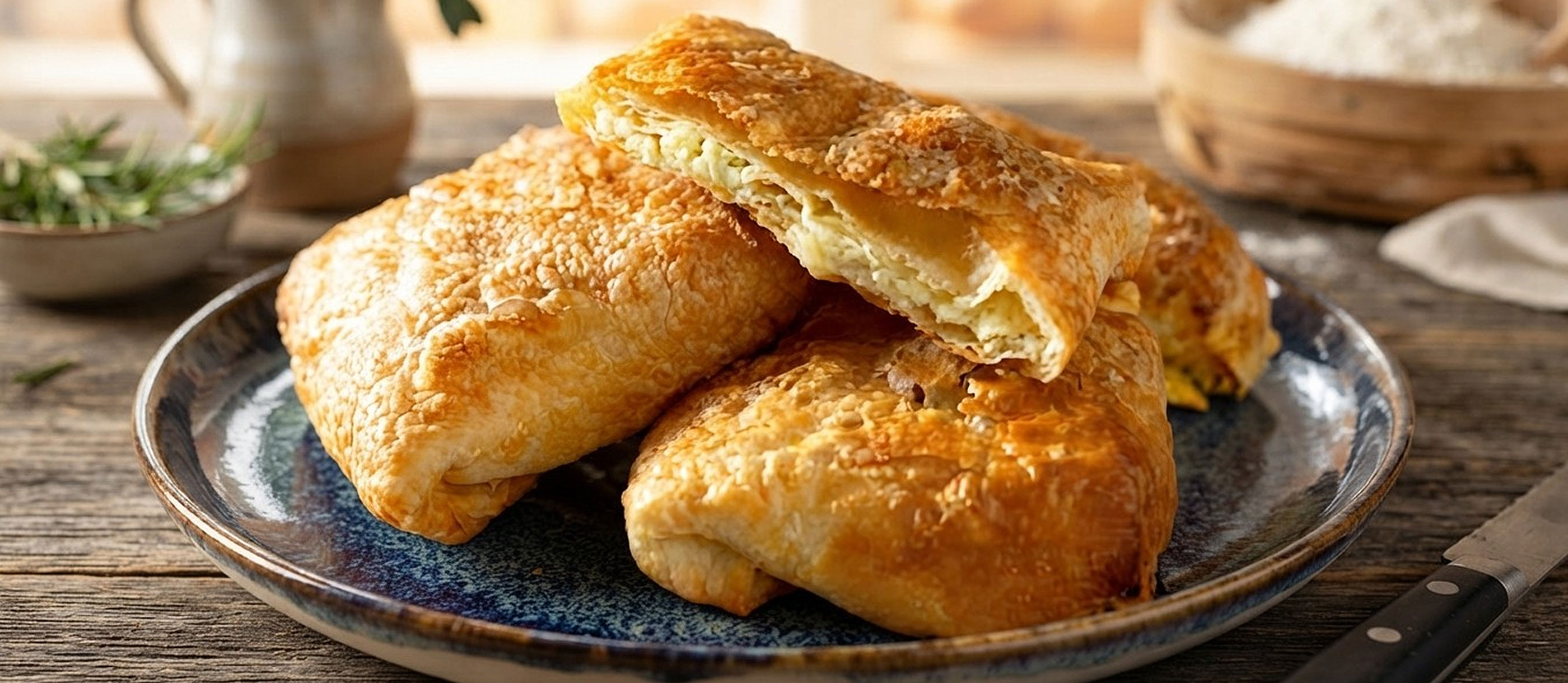
Merdenele are Romanian savory pastries made from layers of folded dough filled most commonly with salty cheese and baked until the exterior is crisp and deeply browned. The singular form is merdenea , while merdenele is the plural normally encountered on bakery signs and in everyday speech. They are found throughout Romania but are particularly associated with urban bakeries, street-side patisseries, railway stations, markets, and the everyday food culture of Bucharest and southern Romania. A typical merdenea is square or slightly rectangular, relatively flat, rich in fat, and large enough to serve as a substantial snack rather than a small pastry. Its filling is usually based on telemea, often combined with cow's-milk curd cheese or another softer cheese and egg, producing a salty, moist center surrounded by crisp, flaky layers. The Romanian term comes from Turkish merdane , a word for a rolling pin or slender implement used to roll dough, reflecting the close connection between the pastry and the techniques of Ottoman and Balkan sheet-pastry making. Merdenele belong to the broader group of filled pastries that circulated for centuries through the Ottoman Empire, the Balkans, Anatolia, and southeastern Europe. It is therefore difficult to identify a single moment or individual responsible for their creation. Their establishment in Romania is generally connected with Ottoman culinary influence and especially with Dobrogea and the southern part of the country, regions that had long-standing contact with Turkish and Tatar communities and with the pastry culture of the Ottoman world. From there, the pastry became familiar farther inland and was already known in different parts of Romania before the twentieth century was well advanced. Accounts of Romanian food culture also associate the sale of merdenele with Turkish and Albanian pastry makers and street vendors, who sold filled pastries in busy urban areas and markets. The linguistic development is particularly useful for understanding the food. In Turkish, merdane refers to the implement used for rolling dough, while Romanian sources record merdenea both as a regional word for a pastry-rolling rod and as the name of the finished pastry. One linguistic explanation connects the culinary meaning more specifically with Turkish merdane böreği , a type of rolled pastry whose name was shortened after entering Romanian usage. Whatever the exact linguistic path, the name places the merdenea firmly within the family of Ottoman-derived pastries based on thin or repeatedly folded dough. Once established in Romania, however, the merdenea developed a recognizable form of its own. Rather than referring broadly to many types of börek, the Romanian word came to mean a specific individual pastry, usually square, compact, flaky, and filled with salty cheese. By the twentieth century it had become firmly associated with urban bakery culture. Romanian gastronomic writer Radu Anton Roman included merdenele among the foods of the country and described both cheese and meat fillings, although the cheese version became by far the most familiar form sold by modern bakeries. His cheese filling used sheep's-milk telemea with butter and eggs, while the meat version combined mutton and beef with onion, egg, pepper, and allspice. The dough is responsible for much of the character of a merdenea. It is generally made from wheat flour, water, and salt, sometimes with a small amount of vinegar, and it normally contains no yeast. Instead of rising through fermentation, the pastry develops its layered structure through repeated rolling, spreading with fat, folding, and resting. Butter, lard, margarine, or combinations of these fats have all been used. In commercial Romanian patisseries, margarine became especially common because it is inexpensive, stable, and suitable for producing clearly separated pastry layers on a large scale, while home recipes frequently use butter or lard. The basic dough is kneaded until smooth, allowed to rest, divided into portions, rolled thinly, coated with softened fat, and folded repeatedly. Chilling or resting between stages helps the fat remain separated from the dough, creating the layers that expand during baking. The cheese filling is usually deliberately salty. Telemea, a brined white cheese widely eaten in Romania, provides most of the flavor, while a less salty cow's-milk cheese may be added to soften the texture and control the salt level. Egg helps bind the mixture, and some recipes add semolina when the cheese contains too much moisture. Keeping the filling reasonably dry is important because excess whey can soften the dough and prevent the inner layers from baking properly. To form the characteristic shape, a portion of laminated dough is rolled into a square or rectangle, the cheese mixture is placed in the center, and the edges or corners are folded inward so that the filling is completely enclosed. The parcel is normally placed seam-side down on a baking tray. Some versions are brushed with egg before baking, although the surface of a bakery merdenea can also be left relatively plain. In the oven, the fat between the layers melts while moisture in the dough turns to steam, separating the sheets and creating the flaky structure. A well-made merdenea should have a crisp, browned exterior, clearly defined layers around the edges, and a softer interior where the dough meets the cheese. It is richer and heavier than many forms of puff pastry, and a certain amount of fat on the fingers or paper wrapping is considered normal for the bakery style. Its square folded construction is also one of the easiest ways to distinguish it visually from Romanian pateuri , plăcinte , and other cheese pastries. Although industrial puff pastry can be used to make a similar product quickly, the more characteristic method starts with a simple dough that is manually coated with fat and folded into layers rather than using ready-made puff pastry sheets. Merdenele became particularly well suited to city life because they are inexpensive, filling, portable, and can be eaten without plates or cutlery. They are usually sold individually from glass-fronted bakery counters and handed over in a paper bag or wrapped in bakery paper. They are best eaten warm, while the exterior remains crisp and the cheese filling is soft. Once completely cold, the fat firms and the pastry becomes denser, which is one reason bakeries often sell them directly from warm trays throughout the day. Radu Anton Roman specifically recommended eating merdenele hot with cold bragă , the lightly fermented cereal drink once much more common in Romanian towns. That pairing also reflects the wider Balkan context in which rich, salty pastries are commonly balanced by cool, mildly acidic or fermented drinks. A merdenea can therefore also be paired successfully with sana, kefir, plain drinking yogurt, or ayran, particularly when the filling is strongly salted. Coffee or black tea are practical alternatives for breakfast, while a light lager works well when the pastry is eaten later in the day. Because the pastry already combines bread, fat, and cheese, it is normally eaten on its own rather than served with a substantial side dish. Today merdenele remain common across Romania, especially in Bucharest and other large cities, where they are bought for breakfast, during work or school breaks, while commuting, or simply as a quick hot snack from a neighborhood bakery. Their defining qualities remain straightforward: folded layered dough, a generous salty-cheese filling, a square shape, a crisp exterior, and the expectation that they will be eaten warm soon after they leave the oven.
02 / ОСНОВНЫЕ ПРОДУКТЫ БЛЮДА
Завтраки · Снеки · Уличная еда
ещё не извлечены
03 / РЕЦЕПТ
В сохранённых данных рецепта нет.
Запись · 13006