02 / ОСНОВНЫЕ ПРОДУКТЫ БЛЮДА
Блюда с лапшой
ещё не извлечены
English · русское название ещё не добавлено
01 / О БЛЮДЕ
Исходное описание на английском языке. Русский перевод ещё не добавлен.
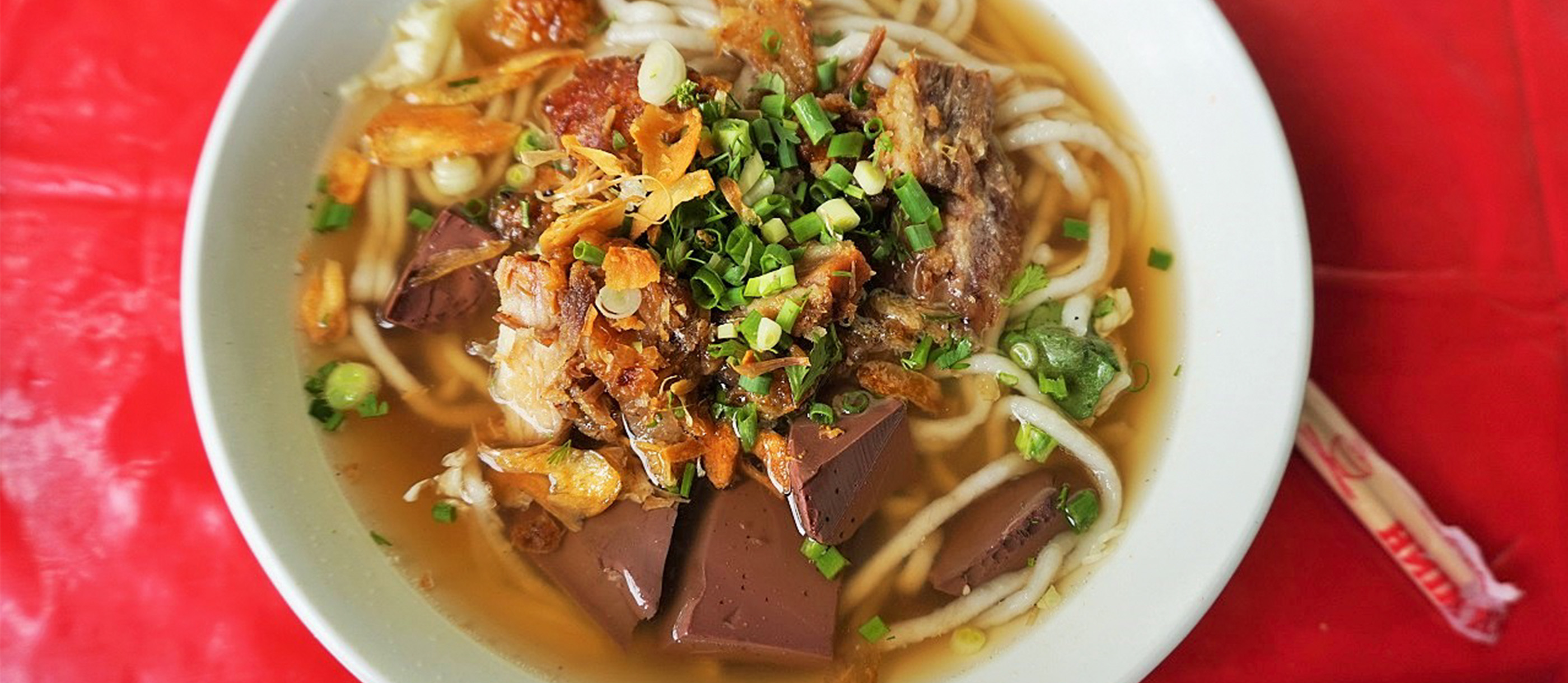
Khao poon is a Lao food based on thin fermented rice noodles, and the same name is commonly used for dishes in which those noodles are served with a seasoned broth or sauce, vegetables, herbs, and meat or fish. Outside Laos, khao poon is often described as a spicy Lao noodle soup with a reddish broth made from coconut milk, chilies, aromatics, fermented fish sauce, and shredded chicken, pork, or fish, but this is only one form of a broader category. The defining element is the noodle itself: a fine, soft noodle made from fermented rice batter and extruded directly into boiling water. Closely related fermented rice noodles are found elsewhere in mainland Southeast Asia, including khanom chin in Thailand and bún in Vietnam, but khao poon has a distinct place in Lao cooking and is eaten throughout the country, from Luang Prabang and Vientiane to southern provinces such as Champasak. There is no securely documented inventor or precise date for khao poon. It developed within the rice-growing cultures of mainland Southeast Asia, where fermentation, wet milling, steaming, and extrusion provided a way of turning rice into fresh noodles with a softer and more elastic texture than dried rice vermicelli. The dish was firmly established in Laos by the early twentieth century, and recipes recorded by Phia Sing, a cook in the royal household of Luang Prabang, show that khao poon already existed in several distinct forms, including khao poon nam phik and khao poon nam jaew. This is important because it shows that khao poon was never limited to the coconut-based curry soup that is now most familiar outside Laos. The noodles are made by soaking rice and allowing it to ferment for several days before grinding it with water. Depending on the method, the resulting flour or paste may ferment further. After excess water is removed, part of the rice dough is steamed or heated so that some of the starch gelatinizes, then mixed back with the remaining dough and enough water to produce a thick paste. This is forced through a perforated press directly into boiling water, forming long, thin strands. The cooked noodles are rinsed in cool water and gathered into small coils or bundles. Fermentation gives khao poon its faint acidity and characteristic aroma while also affecting the softness and elasticity of the noodles. Because fresh khao poon is highly perishable and noodle making requires time and specialized equipment, many households have historically bought it from local noodle makers and markets rather than producing it for every meal. One of the best-known preparations is khao poon nam phik, a rich dish made with meat or fish, fermented fish, chilies, aromatics, and coconut milk. Older recorded versions combine pork and fish with galangal, garlic, spring onions, padaek, coconut milk, fried chilies, and lime. In many contemporary versions, especially khao poon nam kati, chicken is simmered until tender, shredded or pounded, and returned to a broth flavored with dried chilies, shallots, garlic, galangal, lemongrass, makrut lime leaves, coconut milk, fish sauce, and padaek. Bamboo shoots are also common. Pork, fish, and duck can replace chicken, and the meat is often finely shredded or pounded rather than served in large pieces, creating a broth in which the protein is distributed throughout the liquid. Coconut milk is not essential. Khao poon nam jaew is an established lighter form made without a rich coconut broth and may include pork, offal, herbs, aromatics, and a strongly seasoned sauce. Other versions are named after their main protein or broth. What defines khao poon more clearly than any single recipe is the combination of fermented rice noodles, a strongly seasoned liquid or sauce, and a generous assortment of vegetables and herbs. Finely shredded cabbage, banana blossom, bean sprouts, long beans, mint, coriander, spring onions, mustard greens, and other fresh leaves may be added to the bowl. Banana blossom is usually sliced very thinly and kept in acidulated water to prevent discoloration. Lime wedges and extra chilies are served alongside so each person can adjust the heat and acidity. The noodles are already cooked before serving and are not simmered for long in the broth. A portion is placed in a bowl with vegetables and herbs, and the hot broth or sauce is ladled over just before eating. This keeps the noodles soft but distinct and allows the fresh vegetables to retain some crispness. The method also makes khao poon practical for large gatherings, since the noodles and vegetables can be portioned in advance while the broth is kept hot. For this reason, it is widely associated with weddings, ceremonies, family gatherings, and communal meals as well as everyday market and home cooking. What distinguishes khao poon from a generic rice-noodle curry is the combination of fermented fresh noodles, Lao seasonings such as padaek, finely shredded or pounded meat or fish, and a large quantity of fresh vegetables and herbs added at serving time. The fermented noodles contribute their own texture and flavor, while padaek gives many versions a distinctly Lao savory character. Although the coconut-based red version is sometimes compared with laksa, khao poon is better understood as its own Lao noodle category, with several established forms, including versions without coconut milk. Khao poon is eaten throughout Laos in homes, markets, noodle shops, and at celebrations, usually as a complete meal. Rich coconut-based versions are commonly served with shredded cabbage, banana blossom, bean sprouts, mint, coriander, and lime, while lighter and more intensely savory versions benefit from the same fresh accompaniments. It does not usually require rice or bread, since the noodles provide the starch. If additional foods are served, grilled chicken, freshwater fish, Lao sausages, or simple vegetable dishes work well alongside it. Cold water and unsweetened tea are straightforward beverage pairings, while Beerlao works particularly well with versions that are spicy, rich in coconut milk, or strongly seasoned with fermented fish. The usual way to eat khao poon is to place fermented rice noodles and fresh vegetables in a bowl, cover them with hot broth, adjust the seasoning with chili and lime, and eat immediately while the noodles remain soft and the vegetables retain their texture.
02 / ОСНОВНЫЕ ПРОДУКТЫ БЛЮДА
Блюда с лапшой
ещё не извлечены
03 / РЕЦЕПТ
В сохранённых данных рецепта нет.
Запись · 6135