01 / ПАСПОРТ
- Категория
- Крахмалистые гарниры
- Страна
- Нигерия
- Регион
- не указан
English · русское название ещё не добавлено
О БЛЮДЕ
Исходное описание на английском языке. Русский перевод ещё не добавлен.
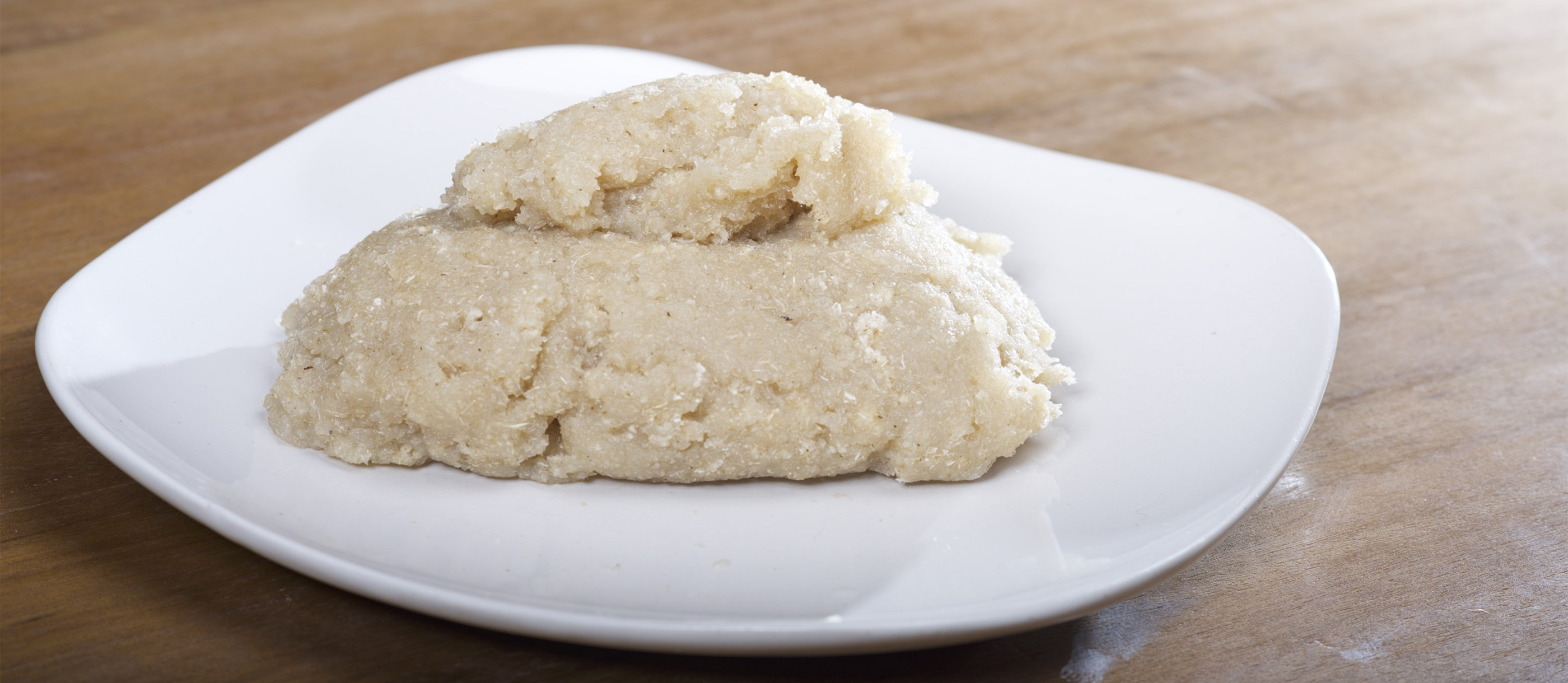
Eba is a dense, pliable dough made by forcefully folding roasted, fermented cassava granules into violently boiling water until it solidifies into a smooth, elastic mass. Portuguese merchants sailing from Brazil introduced the raw cassava tuber to the West African coast during the middle of the 16th century. To neutralize the naturally occurring cyanide compounds in the raw root and extend its shelf life in the extreme tropical humidity, indigenous Yoruba and Igbo communities engineered a strict method of peeling, grating, fermenting, and dry-roasting the wet mash. This extensive agrarian labor produced a dry, granular flour known as garri, which became the sole foundational ingredient for this specific dough. Building the dense starch requires exactly two ingredients and immediate temperature control. A large volume of water reaches a rolling boil in a metal pot. The dry cassava granules are sprinkled steadily and evenly directly onto the violently hot liquid. The mixture sits completely undisturbed for exactly one minute, allowing the dry starches to rapidly swell and absorb the moisture. A thick wooden baton, locally called an omorogun, forcefully beats the hydrating granules against the pot's inner walls. The intense physical folding completely crushes any dry lumps, binding the loose granules into a single, cohesive sphere. The specific roasting method for raw cassava determines the final color and flavor profile of the dough. Yellow eba results from incorporating unrefined red palm oil directly into the massive iron roasting pans during milling, injecting a deeply earthy flavor and a bright orange hue into the dry granules. White eba omits the palm oil entirely, yielding a pale dough that retains a sharper, more acidic sourness from the initial fermentation phase. Adjusting the ratio of boiling water to dry flour directly alters the structural integrity, ranging from a highly rigid, stiff block to a loose, sticky paste. The hot starch is moved directly from the pot to a wide bowl, where it is quickly shaped by hand into a smooth, uniform mound. A thin sheet of clear plastic tightly wraps the hot sphere to trap the escaping steam and prevent a hard crust from forming on the exterior. The heavy dough always pairs well with highly viscous, aggressively spiced liquids like pounded melon seed stew, known as egusi, or sticky okra soup. Consuming the meal strictly involves using bare fingers to pinch off a bite-sized piece, rolling it into a tight ball, pressing a small indentation into the center with a thumb, and plunging it directly into the hot stew to scoop up large amounts of meat and heavy oil.
03 / РЕЦЕПТ
Рецепт для этого блюда пока не добавлен.