02 / ОСНОВНЫЕ ПРОДУКТЫ БЛЮДА
ещё не извлечены
English · русское название ещё не добавлено
01 / О БЛЮДЕ
Исходное описание на английском языке. Русский перевод ещё не добавлен.
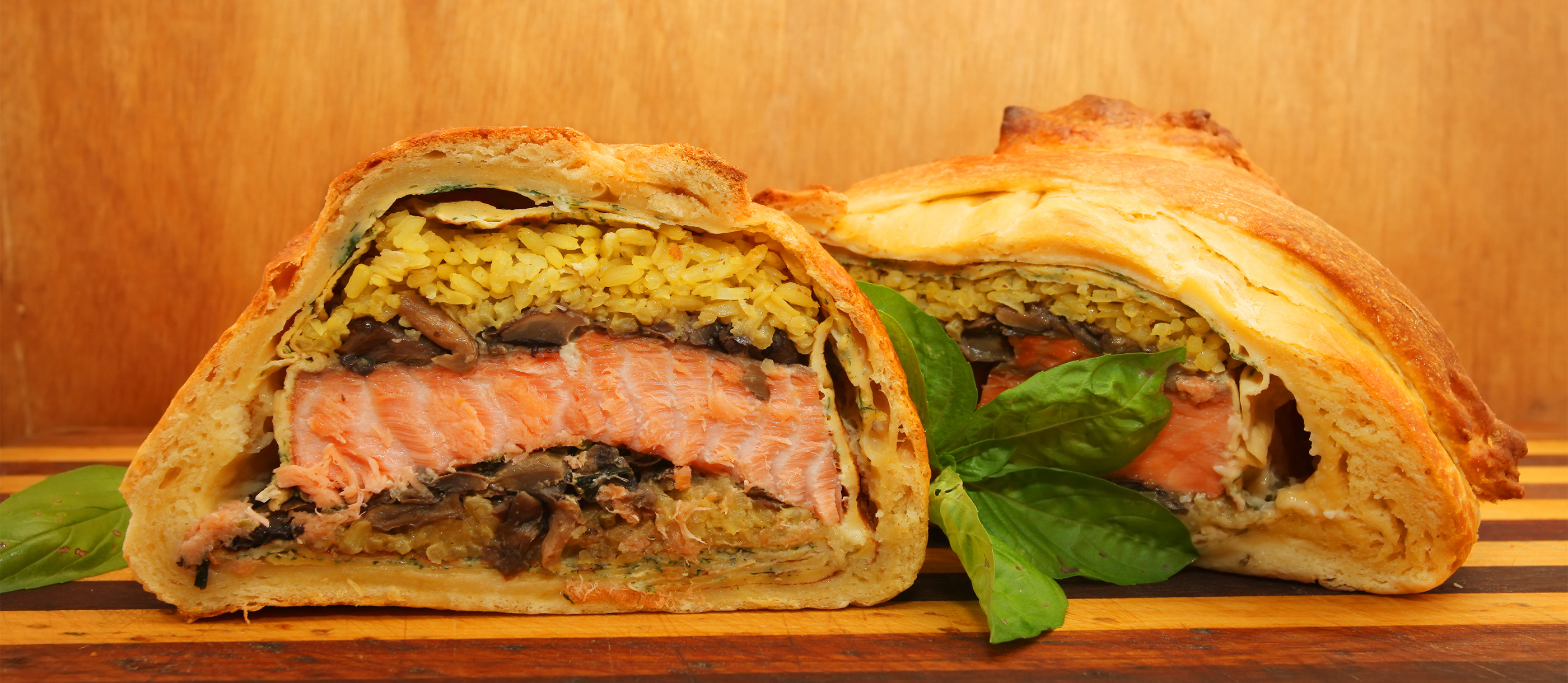
Coulibiac, also known as koulibiac and derived from the name kulebyaka, is a fully enclosed savory pie built around a substantial filling sealed inside yeasted dough, brioche, or puff pastry. The most elaborate fish versions contain distinct layers of salmon or sturgeon, rice or buckwheat, hard-boiled eggs, mushrooms, onions, herbs, and sometimes vesiga, a dried part of the sturgeon’s spinal structure. Thin pancakes may separate the fillings so that the layers remain distinct when the pie is sliced. The pie originated in the Russian Empire, but its earliest history is less precise than sometimes claimed. Historical and etymological sources place forms of the word in the 17th century, while surviving references vary in date. By the 18th and especially the 19th century, kulebyaka had become an established category of filled pie rather than one fixed formula. Fillings included fish, meat, cabbage, mushrooms, onions, buckwheat, eggs, and other ingredients. It was also not simply a winter food created for agricultural laborers. Kulebyaka appeared across a broad range of households and eventually developed into an elaborate centerpiece associated with substantial meals and festive tables. Nineteenth-century versions could become exceptionally complex, with several separate fillings arranged in layers or sections. Nikolai Gogol even describes an elaborate multi-filled fish kulebyaka in Dead Souls, including sturgeon cheeks, vesiga, buckwheat, mushrooms, onions, roe, and other fillings. During the 19th century, culinary exchange between the Russian Empire and France helped bring the pie into Western European restaurant culture. French culinary professionals working for wealthy households encountered increasingly elaborate versions, and the name entered French as coulibiac or koulibiac. The international version became particularly associated with salmon. Auguste Escoffier gave coulibiac a major place in classical restaurant cuisine when he included Coulibiac de Saumon in the first edition of Le Guide Culinaire in 1903. His formula is unusually useful because it documents the structure of an elaborate salmon coulibiac in precise detail. Escoffier’s version begins with a firm, unsweetened brioche dough rolled into an oblong. The filling consists of salmon cut into small escalopes and lightly set in butter, chopped mushrooms and onion cooked in butter, hard-boiled eggs, kasha or rice, and cooked vesiga. These components are placed one above another, beginning with grain and ending with another layer of grain. The grain varies according to the version. Buckwheat kasha is strongly associated with older kulebyaka, while rice became equally common in refined fish versions. Fresh dill or parsley may be mixed through the grain or other fillings, providing a sharp herbal note against the richness of salmon, eggs, butter, and pastry. Modern versions frequently combine rice with dill. Vesiga, also written vyaziga, is one of the most distinctive historical ingredients. It is not literally sturgeon spinal marrow, as it is sometimes described. It comes from the dried notochord, the flexible cord running through the spine of sturgeon and related fish. Once dried, it keeps well; before use, it must be soaked and then simmered for several hours until tender. Thin pancakes are another feature of especially elaborate versions. Rather than simply lining the bottom of the pastry, they can be placed between different fillings, helping separate wet components and creating clearly defined sections when the pie is cut. This technique is particularly useful in large coulibiacs containing several contrasting fillings. A common modern version starts with rice or buckwheat seasoned with dill, followed by salmon or sturgeon, sautéed mushrooms and onions, chopped hard-boiled eggs, and another layer of grain. Depending on the formula, pancakes can sit between some or all of these layers. The filling is piled into an elongated mound before the outer dough is wrapped completely around it and sealed. Brioche is historically well established, but puff pastry has become equally recognizable. Escoffier himself documented both. Puff pastry produces a lighter, more brittle shell, while yeasted dough gives the pie a softer, bread-like casing capable of supporting a particularly heavy filling. The formed pie is brushed with egg so that the surface browns evenly. Small openings or punctures allow steam to escape and reduce the risk of splitting. The finished crust should be deeply golden and firm enough to hold the filling when cut. Inside, the grain absorbs fish juices and butter, the mushrooms and onions contribute moisture and savoriness, the eggs provide richness, and the fish remains tender rather than dry. Although salmon coulibiac is now the best-known form internationally, kulebyaka has never been limited to fish. Meat, cabbage, mushrooms, potatoes, and grains all have established precedents. Beef or pork can replace fish, often with onions, eggs, buckwheat, rice, or cabbage. Cabbage-filled versions are especially well established rather than merely modern substitutions. Entirely meat-free versions may use cabbage, mushrooms, potatoes, buckwheat, lentils, or root vegetables, although green lentils are more characteristic of contemporary adaptations than of the older canon. The pie is generally brought to the table whole and sliced crosswise into substantial portions. A well-built coulibiac reveals its internal structure immediately: pastry surrounding clearly visible bands of grain, fish, eggs, mushrooms, and other fillings. The slices need to be thick enough to keep those layers intact. Melted butter is an especially well-documented finish. Escoffier instructed that fresh melted butter be introduced through the steam opening immediately after the pie left the oven. The butter penetrates the grain and other fillings, adding moisture and richness before slicing. Some versions add a small quantity of broth to the filling to keep it juicy, and kulebyaka may also be served alongside broth. Pouring broth through an opening is more strongly associated with rasstegai, the smaller open-topped pie designed specifically to receive broth through its central opening. Coulibiac can therefore range from a comparatively simple cabbage or meat pie to an elaborate layered centerpiece.
02 / ОСНОВНЫЕ ПРОДУКТЫ БЛЮДА
ещё не извлечены
03 / РЕЦЕПТ
В сохранённых данных рецепта нет.
Запись · 2971