01 / ABOUT THE DISH
About the dish
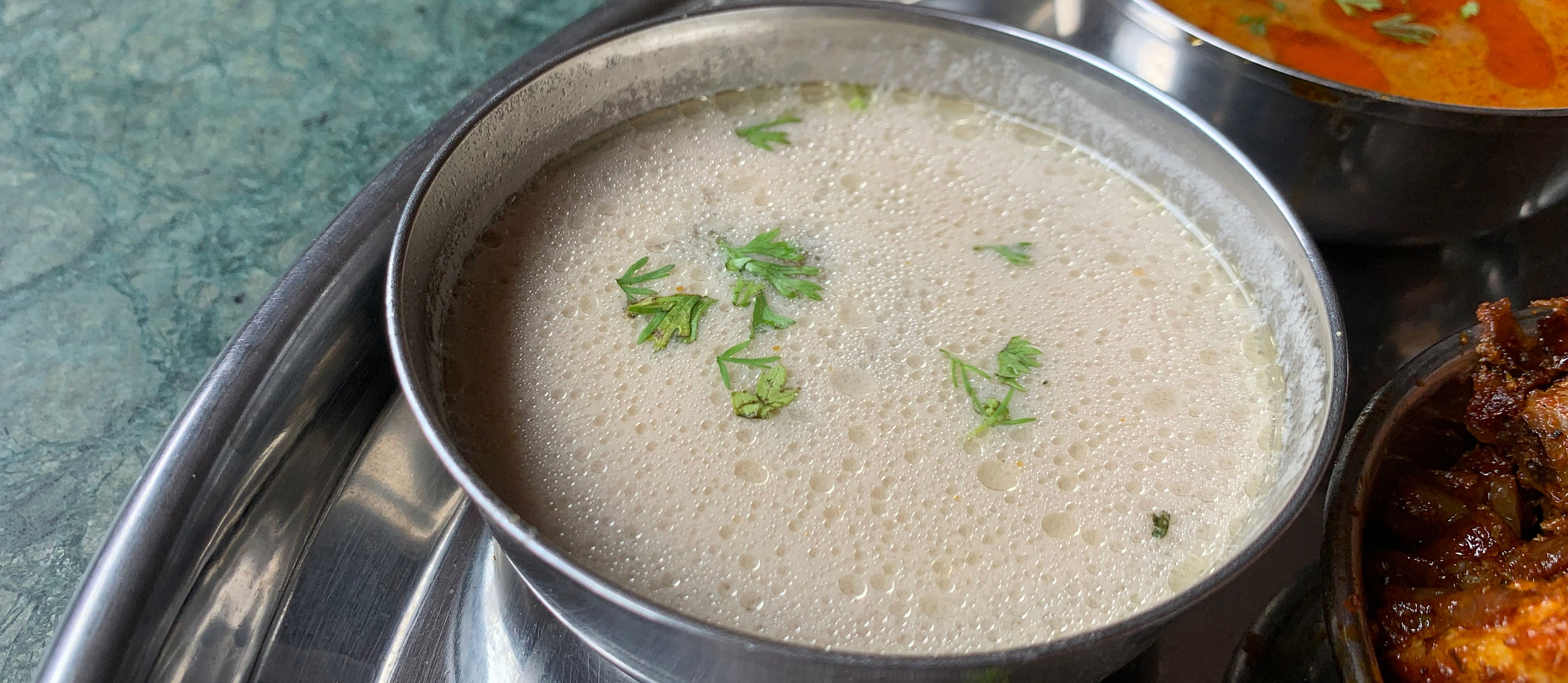
Pandhra rassa is a pale mutton gravy, made mainly from mutton stock, coconut, and a restrained mixture of aromatic spices. In Marathi, pandhra means white and rassa refers to a thin gravy or broth. The characteristic version uses stock from bone-in goat or mutton, enriched with coconut milk or a finely ground coconut paste and ingredients such as sesame seeds, poppy seeds, cashews, black pepper, ginger, garlic, cardamom, cloves, cinnamon, and bay leaf. It is much milder in chili than the deep red tambda rassa served alongside it, but it is not bland; much of its flavor comes from meat stock, coconut, pepper, and warming spices. Pandhra rassa is closely tied to the Kolhapuri mutton thali, where it is commonly served with tambda rassa, mutton fry or sukka, bhakri, chapati, and rice. There is no securely documented creator or precise date for the dish. It developed within the meat cooking of Kolhapur and neighboring parts of southwestern Maharashtra, where goat meat, coconut, sesame, poppy seeds, pepper, and ground masalas are widely used. By the mid-twentieth century, the pairing of pandhra and tambda rassa was already firmly established in Kolhapur’s restaurant culture and became one of the defining features of the city’s non-vegetarian thalis. Both rassas commonly begin with the same basic ingredient: mutton stock. Bone-in goat or mutton is simmered or pressure-cooked with water, salt, and often ginger, garlic, turmeric, or onion until tender. The cooked meat can then be used for mutton fry, sukka, or another dish, while the stock is divided between the rassas. This explains why pandhra rassa may contain little or no meat despite being unmistakably a meat preparation. Its flavor depends heavily on the gelatin, fat, and juices extracted during cooking. The pale base is usually made from fresh coconut or coconut milk. In some versions, coconut is ground with poppy seeds, white sesame seeds, melon seeds, or cashews to form a smooth paste. These ingredients give the broth body without darkening it significantly. Onion may be softened only until translucent rather than deeply browned, helping preserve the light cream-to-white color. The spice profile is deliberately restrained. Black or white pepper provides much of the heat, while cloves, cinnamon, cardamom, bay leaf, cumin, ginger, and garlic add aroma. Some recipes use green chilies, fennel, nutmeg, or coriander seed, but large quantities of red chili are avoided. The aim is to create a broth that is peppery and aromatic rather than chili-driven. Preparation generally involves cooking the mutton stock separately, then gently frying the whole spices in oil or ghee. A pale onion-ginger-garlic paste and the coconut-and-seed mixture are added and cooked without excessive browning. The reserved mutton stock is then poured in and simmered until the flavors combine. Coconut milk may be added toward the end and heated gently, since prolonged boiling can cause it to separate. The consistency should remain thin and pourable rather than becoming a heavy nut or coconut curry. Pandhra rassa can be sipped directly from a bowl, poured over rice, or eaten with pieces of bhakri. Cream is not required; its richness and pale color should come from coconut, meat stock, and the ground seed-and-nut mixture. Pandhra rassa and tambda rassa are best understood as complementary preparations. Tambda rassa is red, chili-forward, oily, and intensely seasoned, while pandhra rassa is pale, coconut-rich, peppery, and comparatively gentle. Diners often alternate between them during a mutton meal, with the white broth providing contrast to the stronger heat of the red rassa. Mutton stock is fundamental to its identity. Chicken versions are now common, but the form most strongly associated with the Kolhapuri mutton thali is based on goat or mutton. It should also not be confused with northern Indian white gravies, which are often based on yogurt, cream, or large quantities of cashews. In pandhra rassa, coconut and mutton broth remain the defining liquids. It is most characteristically eaten as part of a full Kolhapuri mutton thali with mutton fry or sukka, tambda rassa, bhakri or chapati, rice, raw onion, and lemon. Jowar bhakri works especially well because its mild flavor and firm texture absorb the broth, while rice is equally suitable. Raw onion and lemon add freshness and acidity against the coconut and mutton fat. For beverages, taak, or spiced buttermilk, works particularly well with the full meal, while a cold lager is another good option when both rassas and spicy mutton dishes are served together.